

In the dynamic business landscape of the Greater Toronto Area (GTA), your IT infrastructure is more than just a convenience; it’s the backbone of your operations. Choosing the right IT support model is a critical decision that can significantly impact your productivity, security, and bottom line. This article explores the two primary approaches to IT support: managed IT services and break-fix support, helping you determine which model best suits your business needs.
Understanding the nuances of each model is crucial for making an informed decision. We will delve into the costs, benefits, and potential pitfalls of both approaches, providing actionable insights to guide you toward a more resilient and efficient IT environment. Don’t let outdated thinking leave your business vulnerable; discover the best path forward for your technology needs in 2026.
Is Your GTA Business Relying on Reactive IT Support?
The Hidden Costs of ‘If It Ain’t Broke…’
The allure of the “if it ain’t broke, don’t fix it” mentality can be strong, especially when budgets are tight. However, relying solely on reactive IT support can introduce significant, often hidden, costs for your GTA business. These costs go beyond the immediate expense of fixing a broken server or resolving a network outage. Consider the lost productivity when employees are unable to work due to IT issues. Every minute of downtime translates to lost revenue and frustrated staff. For example, a small accounting firm with 15 employees experiencing a two-hour server outage could lose approximately $1,500 in billable hours, not to mention the potential damage to client relationships due to missed deadlines.
Moreover, reactive IT support often leads to a cycle of patchwork fixes. Instead of addressing the root cause of the problem, break-fix technicians may implement temporary solutions that mask underlying issues, leading to recurring problems and escalating costs over time. This approach also leaves your business vulnerable to security threats, as proactive security measures are typically not part of the break-fix model. As discussed on this page, a proactive approach to IT security can dramatically reduce your risk of becoming a cyberattack victim.
Why Break-Fix Often Fails Small to Mid-Sized Businesses
While the break-fix model might seem appealing for its apparent simplicity, it often falls short of meeting the needs of small to mid-sized businesses (SMBs) in the GTA. One of the key reasons is the lack of strategic planning. Break-fix support is inherently reactive; it doesn’t involve assessing your long-term IT needs or aligning your technology with your business goals. This can lead to a fragmented IT infrastructure that hinders growth and innovation. For instance, a growing e-commerce business relying on break-fix support might find that its outdated website and inadequate server capacity can’t handle increased traffic during peak seasons, resulting in lost sales and customer dissatisfaction.
Furthermore, break-fix support typically lacks the proactive monitoring and maintenance necessary to prevent problems before they occur. This means that your business is constantly operating in a state of vulnerability, waiting for the next IT disaster to strike. For smaller teams, this can place undue stress on internal resources who may be unable to troubleshoot complex issues quickly and efficiently. As a result, smaller businesses risk being unable to handle outages or adapt to new technologies as they scale. You can explore typical break-fix limitations for SMBs in more detail.
Spotting the Signs: Is Break-Fix Holding You Back?
Several telltale signs indicate that your GTA business may be held back by relying on break-fix IT support. One common sign is frequent and unpredictable IT issues. If you find yourself constantly dealing with recurring problems, such as slow network speeds, printer malfunctions, or email outages, it’s a clear indication that your IT infrastructure is not being properly maintained. Another sign is a lack of a clear IT budget. With break-fix support, you never know when the next IT emergency will arise, making it difficult to plan your finances effectively.
Additionally, if your business is struggling to keep up with the latest cybersecurity threats, it’s likely that your break-fix provider is not providing adequate security protection. Many break-fix providers are not specialized in cybersecurity, leaving you vulnerable to data breaches, malware infections, and other cyberattacks. If your team spends a significant portion of their time troubleshooting technical issues rather than focusing on core business activities, it’s time to consider managed IT services.
Managed IT Services: A Proactive Approach to Tech in the GTA
What Does ‘Managed’ Really Mean? Core Components Explained
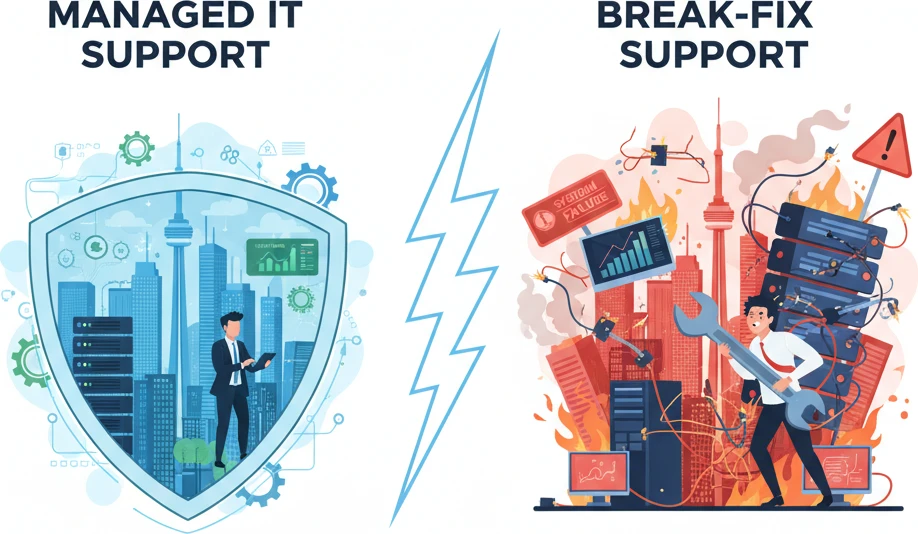
Managed IT services represent a fundamental shift from reactive break-fix support to a proactive, comprehensive approach to technology management. At its core, “managed” means that a third-party provider assumes responsibility for the ongoing maintenance, monitoring, and support of your IT infrastructure. This includes a range of core components, such as 24/7 monitoring of your network and servers to detect and resolve potential issues before they impact your business. A managed IT provider also provides proactive maintenance, including regular software updates, security patches, and system optimization to keep your IT environment running smoothly.
Furthermore, managed IT services typically include help desk support, providing your employees with a single point of contact for all their IT-related issues. This ensures that problems are resolved quickly and efficiently, minimizing downtime and maximizing productivity. Managed IT providers often offer strategic IT consulting, helping you align your technology with your business goals and develop a long-term IT roadmap. This allows you to make informed decisions about your technology investments and ensure that your IT infrastructure is scalable and adaptable to your evolving needs. As highlighted on this page, a well-managed IT environment can be a crucial foundation for robust cybersecurity.
The Proactive Advantage: Preventing Problems Before They Disrupt You
The primary advantage of managed IT services lies in its proactive nature. By constantly monitoring your IT infrastructure and performing regular maintenance, a managed IT provider can identify and resolve potential problems before they escalate into major disruptions. This proactive approach can significantly reduce downtime and improve overall system performance. For example, a managed IT provider might detect a failing hard drive on a server and replace it before it causes a complete system failure, preventing hours of downtime and potential data loss. This is especially useful for organizations such as law firms that rely on timely data access and security for their cases.
Moreover, proactive maintenance can extend the lifespan of your IT equipment, reducing the need for costly replacements. By keeping your software up-to-date and optimizing your systems, a managed IT provider can help you get the most out of your technology investments. Managed IT provides the assurance that your technology is working *for* you, not against you. As noted earlier, this enables you to focus on core business activities and strategic initiatives rather than constantly dealing with IT problems. A good summary of this proactive approach can be found on this Fortinet page.
Cybersecurity as a Cornerstone: Building a Security-First Foundation
In today’s increasingly complex threat landscape, cybersecurity is no longer an optional add-on but a critical component of any IT strategy. Managed IT services typically include robust security measures to protect your business from cyber threats. This includes firewall management, intrusion detection and prevention systems, antivirus and anti-malware software, and security awareness training for your employees. Managed IT providers also conduct regular security audits and vulnerability assessments to identify and address potential weaknesses in your IT infrastructure.
Furthermore, managed IT providers can help you comply with relevant industry regulations and standards, such as PIPEDA and PCI DSS. By implementing strong security controls and providing ongoing security monitoring, a managed IT provider can help you minimize your risk of data breaches, cyberattacks, and other security incidents. They are also crucial for disaster recovery planning, ensuring business continuity if a major incident such as a ransomware attack takes place. To learn more about strengthening your defenses against modern threats, explore this page.
Break-Fix IT Support: Quick Fixes with Long-Term Risks
Understanding the Break-Fix Model: How It Works
The break-fix IT support model, also known as “on-demand” or “time and materials,” operates on a reactive basis. Essentially, you only pay for IT services when something breaks or requires fixing. When an issue arises, you contact a technician or IT service provider, who then diagnoses the problem and implements a solution. You are billed for their time and materials used to resolve the issue. The defining characteristic of this model is its reactive nature. There is no proactive monitoring, maintenance, or strategic planning involved. The IT provider is only engaged when a problem occurs.
The service generally covers a wide variety of potential problems, from server issues and network connectivity problems to software glitches and hardware failures. While this model seems attractive due to its pay-as-you-go approach, it can lead to unpredictable costs and potential disruptions to your business operations. The lack of proactive measures also means that your IT infrastructure is more vulnerable to security threats and performance issues.
When Break-Fix Might Be Sufficient (And When It’s Not)
Break-fix IT support may be sufficient for very small businesses with extremely limited IT needs, such as a sole proprietorship that primarily uses a single computer for basic tasks. In such cases, the cost of managed IT services may outweigh the potential benefits. If the business is comfortable accepting the risks associated with reactive support and has the internal expertise to handle minor IT issues, break-fix might be a viable option. However, even in these scenarios, it’s essential to carefully consider the potential costs of downtime and data loss. Consider also that if the company experiences any significant growth, its IT infrastructure would likely become an increased business risk.
However, for most small to mid-sized businesses in the GTA, break-fix IT support is simply not adequate. As businesses grow and become more reliant on technology, the risks associated with reactive support become increasingly significant. The cost of downtime, data loss, and security breaches can quickly outweigh the perceived savings of break-fix support. Businesses that require reliable IT performance, strong security, and strategic technology planning should consider managed IT services.
The Inherent Uncertainty: Budgeting and Downtime Concerns
One of the biggest drawbacks of the break-fix model is the inherent uncertainty it introduces into your IT budget. Because you only pay for services when something breaks, it’s difficult to predict your IT expenses from month to month. This can make it challenging to plan your finances effectively and allocate resources to other areas of your business. Unexpected IT emergencies can result in significant, unplanned expenses, potentially disrupting your cash flow. This is especially crucial for small businesses operating on tight margins.
Moreover, the reactive nature of break-fix support can lead to prolonged downtime. When an issue occurs, you must first contact a technician, who then needs to diagnose the problem and implement a solution. This process can take hours, or even days, depending on the complexity of the issue and the availability of the technician. During this time, your employees may be unable to work, resulting in lost productivity and revenue. The proactive nature of managed IT avoids these challenges.
Managed IT: Predictable Costs, Predictable Performance
Budgeting with Confidence: Fixed Monthly Fees Explained
One of the key advantages of managed IT services is the predictable cost structure. Instead of paying for IT services on an hourly basis, you pay a fixed monthly fee that covers all of your IT support needs. This allows you to budget with confidence and avoid unexpected IT expenses. The fixed monthly fee typically includes 24/7 monitoring, proactive maintenance, help desk support, and security services. The pricing is usually based on the number of employees, the number of devices, or the complexity of your IT infrastructure.
By eliminating the uncertainty of break-fix pricing, managed IT services can help you control your IT costs and allocate resources more effectively. You know exactly what you’re paying for each month, allowing you to plan your finances with greater accuracy. Many MSPs will also include any hardware and software upgrades within their managed agreement, further reducing unexpected costs and making budgeting simple. This allows SMBs to access enterprise-level support at a predictable cost.
Scalability and Flexibility: Growing Your IT as You Grow Your Business
Managed IT services offer scalability and flexibility, allowing you to easily adjust your IT resources as your business grows and evolves. As you add new employees, open new locations, or implement new technologies, your managed IT provider can quickly scale your IT infrastructure to meet your changing needs. This ensures that your IT environment can keep pace with your business growth without causing disruptions or delays. With managed IT, your IT support scales with you.
Managed IT services also provide flexibility in terms of technology choices. Your managed IT provider can help you evaluate and implement new technologies that can improve your productivity, efficiency, and competitiveness. Whether you’re considering moving to the cloud, implementing a new CRM system, or upgrading your network infrastructure, your managed IT provider can provide expert guidance and support. In short, the agility afforded by Managed IT services helps your business to rapidly evolve and adapt to changes in the marketplace.
Service Level Agreements (SLAs): Guarantees of Uptime and Responsiveness
Managed IT service providers typically offer Service Level Agreements (SLAs) that guarantee specific levels of uptime and responsiveness. These agreements outline the provider’s commitments to you, including the maximum acceptable downtime, the response time for support requests, and the resolution time for IT issues. SLAs provide you with peace of mind knowing that your IT environment will be available when you need it and that any problems will be resolved quickly and efficiently. This helps to make the service feel more tangible than simple assurances of service.
SLAs also hold your managed IT provider accountable for their performance. If they fail to meet the agreed-upon service levels, you may be entitled to compensation or other remedies. This incentivizes the provider to deliver high-quality service and ensures that your IT needs are being met. Careful consideration of the SLA is critical during the selection process to ensure the terms align with your business needs and expectations. For example, if a major portion of your business communication relies on VoIP systems, then the SLA should clearly define the uptime and performance guarantees for those systems. You can find examples of different types of SLAs here.
Cybersecurity: A Critical Differentiator Between Support Models
The Break-Fix Cybersecurity Gap: Reacting to Threats After They Happen
The break-fix model typically involves addressing cybersecurity issues *after* they’ve already caused a problem. This reactive approach leaves your GTA business vulnerable. Imagine discovering a ransomware attack only *after* your critical data has been encrypted. You’re then scrambling to recover, facing potential data loss, significant downtime, and reputational damage. Break-fix cybersecurity is akin to calling a doctor *after* you’re already seriously ill, rather than focusing on preventative care. This puts your business in a constant state of high alert, always one step behind cybercriminals who are continuously developing new and sophisticated threats. Often, businesses utilizing this model may delay security updates or patches to avoid perceived disruptions, further increasing the risk of exploitation.
Managed IT’s Security-First Approach: Proactive Monitoring & Threat Prevention
Managed IT takes a security-first approach, focusing on proactive monitoring and threat prevention. This includes 24/7 network monitoring to detect anomalies and potential intrusions *before* they can escalate into major incidents. For example, a Managed Service Provider (MSP) would implement tools to monitor network traffic for suspicious patterns, block malicious websites, and regularly scan systems for vulnerabilities. They would also proactively manage and deploy security patches and updates, ensuring your systems are always protected against the latest threats. Managed IT providers often implement advanced security solutions, such as Security Information and Event Management (SIEM) systems, to correlate security events and identify potential threats that might otherwise go unnoticed.
Compliance Considerations: Meeting Regulatory Standards with Managed IT
Many industries in the GTA are subject to strict regulatory compliance requirements, such as PIPEDA or industry-specific standards. A break-fix approach often struggles to maintain compliance, as it lacks the consistent monitoring, documentation, and reporting capabilities required. In contrast, managed IT providers specialize in compliance management, implementing security controls and procedures to ensure your business meets all applicable regulations. This includes performing regular security audits, maintaining detailed records of security incidents, and providing training to employees on security best practices. For example, a managed IT provider can help your business implement multi-factor authentication, encrypt sensitive data, and develop a comprehensive incident response plan. For more insights, you might also want to check out resources on Cybersecurity Blind Spots in the GTA.
Downtime Costs: Quantifying the Impact on Your Bottom Line
Calculating Downtime: Lost Revenue, Productivity, and Reputation
Downtime can be incredibly costly for GTA businesses. Consider a scenario where a server outage prevents employees from accessing critical applications, leading to a complete halt in operations. This immediately translates to **lost revenue** due to missed sales opportunities and delayed projects. Furthermore, employees are unable to perform their duties, resulting in **reduced productivity**. Beyond the immediate financial impact, downtime can also damage your **reputation**. Customers may lose confidence in your ability to deliver services reliably, potentially leading to lost business. To calculate the true cost of downtime, consider factors such as employee wages, lost sales, potential penalties for missed deadlines, and the cost of recovering from the incident. Many online tools can help estimate downtime costs based on industry and company size.
How Managed IT Minimizes Downtime: Proactive Monitoring and Rapid Response
Managed IT services are designed to minimize downtime through proactive monitoring, preventative maintenance, and rapid response capabilities. MSPs implement systems that continuously monitor your IT infrastructure, identifying potential issues before they escalate into major problems. For instance, if a server’s performance begins to degrade, the MSP can take proactive steps to address the issue, such as optimizing system resources or replacing faulty hardware, before it leads to a complete outage. Moreover, managed IT providers typically have dedicated support teams available 24/7 to respond to incidents quickly and efficiently, minimizing the duration of any downtime. This proactive approach, as explained in this article covering GTA IT Support and Risk Reduction, ensures business continuity.
Case Study: A GTA Business Saves Money with Managed IT (2026 Data)
Example: A Mississauga-based manufacturing company with 60 employees experienced an average of 12 hours of downtime per month due to various IT issues under a break-fix model. After switching to managed IT services, their downtime was reduced to less than 2 hours per month. The company estimated their cost of downtime at $500 per employee per hour. The reduction of 10 hours of downtime translates to a savings of $300,000 annually (60 employees x 10 hours x $500/hour). Moreover, they experienced a 15% increase in productivity due to improved system performance and reduced IT-related disruptions. This case highlights how proactive IT management can significantly reduce downtime costs and improve overall business efficiency. The company also benefited from enhanced cybersecurity protection, preventing several potential ransomware attacks that could have resulted in even greater financial losses. This is one example of how focusing on reducing downtime with Managed IT can improve your business.
Strategic Technology Planning: A Managed IT Advantage
Beyond Fixing Problems: Aligning IT with Business Goals
Managed IT goes beyond simply fixing problems; it’s about strategically aligning IT with your business goals. A good MSP takes the time to understand your business objectives, challenges, and future growth plans. This understanding allows them to develop an IT strategy that supports your overall business strategy. For example, if your goal is to expand into new markets, the MSP can help you implement cloud-based solutions that enable remote collaboration and scalability. Or, if you are planning to improve customer service, they can implement a CRM system and integrate it with your VoIP phone system to provide a seamless customer experience. The goal is to transform IT from a cost center into a strategic asset that drives business growth and innovation.
Technology Roadmaps: Planning for Future Growth and Innovation
A key component of strategic technology planning is the development of a technology roadmap. This roadmap outlines the IT investments and initiatives that will be required to support your business goals over the next 3-5 years. It should include specific projects, timelines, and budgets. For example, the roadmap might include plans to upgrade your network infrastructure, migrate to a cloud-based platform, or implement a new cybersecurity solution. The roadmap should be regularly reviewed and updated to reflect changes in your business environment and technology landscape. The MSP will work with you to prioritize projects based on their potential impact on your business and ensure that your IT investments are aligned with your overall strategic objectives. An effective roadmap also prepares the business to incorporate technological innovations that align with company objectives and create strategic value.
Budgeting and ROI: Justifying IT Investments for Long-Term Success
Managed IT helps you justify IT investments by providing clear visibility into the return on investment (ROI). The MSP can help you track the costs and benefits of each IT project, demonstrating how it contributes to your bottom line. For instance, they can show how a new security solution reduces the risk of costly data breaches, or how a cloud-based platform improves employee productivity and reduces operational costs. This data-driven approach allows you to make informed decisions about IT investments and ensure that you are getting the maximum value for your money. The MSP can also help you develop a long-term IT budget that aligns with your business goals and ensures that you have the resources you need to support your growth. This collaborative budgeting process allows for better prediction of costs and mitigation of unexpected budget overruns.
Making the Switch: A Step-by-Step Guide to Managed IT in the GTA
Assessing Your IT Needs: Identifying Pain Points and Goals
Before making the switch to managed IT, it’s crucial to assess your current IT infrastructure, identify your pain points, and define your goals. Start by documenting all your existing hardware, software, and network components. Then, identify the areas where you are experiencing challenges, such as frequent downtime, security vulnerabilities, or lack of IT support. For example, are your employees struggling with slow internet speeds, or are you constantly dealing with malware infections? Also, consider your future goals. What do you want to achieve with IT? Do you want to improve employee productivity, enhance customer service, or expand into new markets? By clearly defining your needs and goals, you can ensure that you select a managed IT provider that is the right fit for your business.
Finding the Right MSP: What to Look for in a Managed IT Provider
Choosing the right MSP is a critical decision. Look for a provider with a proven track record of success, strong technical expertise, and a deep understanding of your industry. Ask for references and check online reviews. Ensure they offer a comprehensive suite of services that meets your specific needs, including proactive monitoring, cybersecurity protection, cloud services, and IT support. Also, consider their response time and communication style. Do they have a dedicated support team that is available 24/7? Do they communicate clearly and proactively? It’s essential to find a provider that is responsive, reliable, and easy to work with. Finally, carefully review the service level agreement (SLA) to ensure that it meets your requirements. An MSP in the GTA should also be familiar with local regulations and compliance requirements.
Onboarding and Transition: A Smooth Path to Managed Services
A smooth onboarding and transition process is essential for a successful managed IT partnership. The MSP should work closely with you to develop a detailed transition plan that minimizes disruption to your business operations. This plan should include a thorough assessment of your existing IT environment, the implementation of new security measures, and the migration of your data and applications to the managed service platform. The MSP should also provide comprehensive training to your employees on the new systems and processes. Throughout the transition process, the MSP should communicate regularly with you to keep you informed of progress and address any concerns. A well-executed onboarding process ensures that you can quickly realize the benefits of managed IT services without experiencing significant downtime or disruption. To help make that transition even smoother, AYS Technologies offers Managed IT strategic technology guidance.
Questions to Ask Before Choosing an IT Support Provider (Managed or Break-Fix)
Selecting the right IT support provider is a critical decision for any GTA business. Before committing to either a managed IT service or a break-fix model, it’s essential to ask the right questions to ensure the provider aligns with your business needs and security requirements. Don’t shy away from probing into their processes, experience, and the proactive measures they take to prevent issues from arising.
What are their response times and escalation procedures?
Downtime can be costly. Understanding a provider’s response time guarantees is crucial. Ask about their service level agreements (SLAs) regarding initial response and resolution times for different types of issues. For example, what’s the guaranteed response time for a critical server outage versus a minor software glitch? It’s equally important to know their escalation procedures. Who handles complex issues that require specialized expertise? How quickly can they escalate problems to senior engineers or vendor support? Ensure there’s a clear and documented process for handling emergencies and critical system failures. Without knowing these things, your business could face significant disruption during even minor IT issues.
What cybersecurity measures do they implement?
Cybersecurity is paramount in today’s threat landscape. Inquire about the specific cybersecurity solutions offered and how they are tailored to protect your business. Do they offer proactive threat monitoring, vulnerability assessments, penetration testing, and security awareness training for your employees? Ask about their experience with compliance frameworks relevant to your industry (e.g., PIPEDA). Do they use multi-factor authentication (MFA) across all systems, and what is their patching strategy for operating systems and applications? Understanding their approach to data backup and disaster recovery is also critical. A robust cybersecurity strategy is no longer optional but a necessity for safeguarding your business assets and reputation, especially in the GTA, where businesses are constantly targeted.
What is their experience supporting businesses in my industry?
While technical proficiency is important, industry-specific experience can be invaluable. Does the provider have a proven track record of supporting businesses similar to yours? Are they familiar with the specific software, hardware, and compliance requirements common in your industry? For instance, a law firm has different IT needs than a manufacturing company. Ask for case studies or references from clients in your industry. Understanding their experience can help you assess their ability to anticipate and address the unique IT challenges your business may face. This expertise translates to faster issue resolution, better alignment with your business goals, and a stronger overall IT strategy. It is also wise to ask prospective providers to share an example of the type of proposal they would offer to a business like yours.
Why AYS Technologies Canada Inc. is the Trusted Choice for GTA Businesses
AYS Technologies Canada Inc. stands as a trusted IT partner for GTA businesses, delivering not just support, but a strategic advantage in today’s digital landscape. We recognize the distinct needs of businesses operating in the Greater Toronto Area and have tailored our services to address these specific challenges. Our approach is rooted in proactive prevention, ensuring that potential IT issues are identified and resolved before they impact your operations.
Our Proactive Approach: Preventing Problems Before They Impact Your Business
Unlike reactive break-fix models, our focus is on preventing problems before they disrupt your business. We leverage proactive monitoring tools and automated maintenance processes to identify and resolve potential issues before they escalate. Our managed services include regular system health checks, proactive patching, and security assessments to ensure your IT infrastructure is always running smoothly and securely. This proactive approach significantly reduces downtime, improves system performance, and allows you to focus on your core business objectives. By continually monitoring and optimizing your IT environment, we minimize the risk of unexpected disruptions and maximize your operational efficiency. This is the core of our commitment to proactive GTA IT support.
GTA-Specific Expertise: Understanding the Unique Needs of Local Businesses
We possess a deep understanding of the unique challenges faced by businesses in the Greater Toronto Area. From navigating local regulations to supporting the specific technology needs of various industries, we have the expertise to deliver tailored IT solutions that meet your specific requirements. Our team is familiar with the IT landscape of the GTA and has established strong relationships with local vendors and partners. This local expertise allows us to provide responsive and reliable support, ensuring that your IT infrastructure is always aligned with your business goals. We understand the nuances of the GTA market and leverage this knowledge to provide strategic IT guidance that helps you stay ahead of the competition.
Comprehensive Services: From Cybersecurity to Cloud Solutions and Beyond
AYS Technologies offers a comprehensive suite of IT services to address all your technology needs. Our services include robust cybersecurity solutions, cloud migration and management, VoIP phone systems, and strategic IT consulting. We partner with leading technology vendors to deliver best-in-class solutions that are tailored to your specific business requirements. Whether you need help protecting your data from cyber threats, migrating your infrastructure to the cloud, or implementing a new VoIP phone system, we have the expertise and resources to help you succeed. Our comprehensive approach ensures that all aspects of your IT infrastructure are managed and optimized, allowing you to focus on growing your business.
Choosing the right IT support model requires careful consideration. By asking the right questions and partnering with a provider like AYS Technologies, with a proactive approach and GTA-specific expertise, you can ensure your business benefits from reliable, secure, and strategically aligned IT services. Don’t wait to bolster your defenses; explore your cybersecurity blind spots today.